Disclaimer: This post is a personal travel log, independent research documentation, and a private reflection on managing a global investment portfolio. It does not constitute a recommendation, solicitation, or order to buy or sell any financial instruments. All investment decisions in the capital market are entirely the responsibility and risk of each individual.
Yesterday, I ran a stock screening on Investing.com. What I was looking for were stocks with a seemingly expensive P/E (Price to Earnings) ratio, but whose PEG Ratio (Price/Earnings-to-Growth) fell within the 0 to slightly above 1 range (0 – >1). This specific metric indicates that the company is trading at a discount relative to its earnings growth—it is cheap, but definitely not low quality.
During the screening process, I found a massive list of stocks matching these exact criteria. However, after conducting further analysis by evaluating their fair value, price action, overall market conditions as shown by the EMA 200 and MACD indicators, and their availability on the investment app I use, only 2 stocks remained worthy of being added to my investment watchlist.
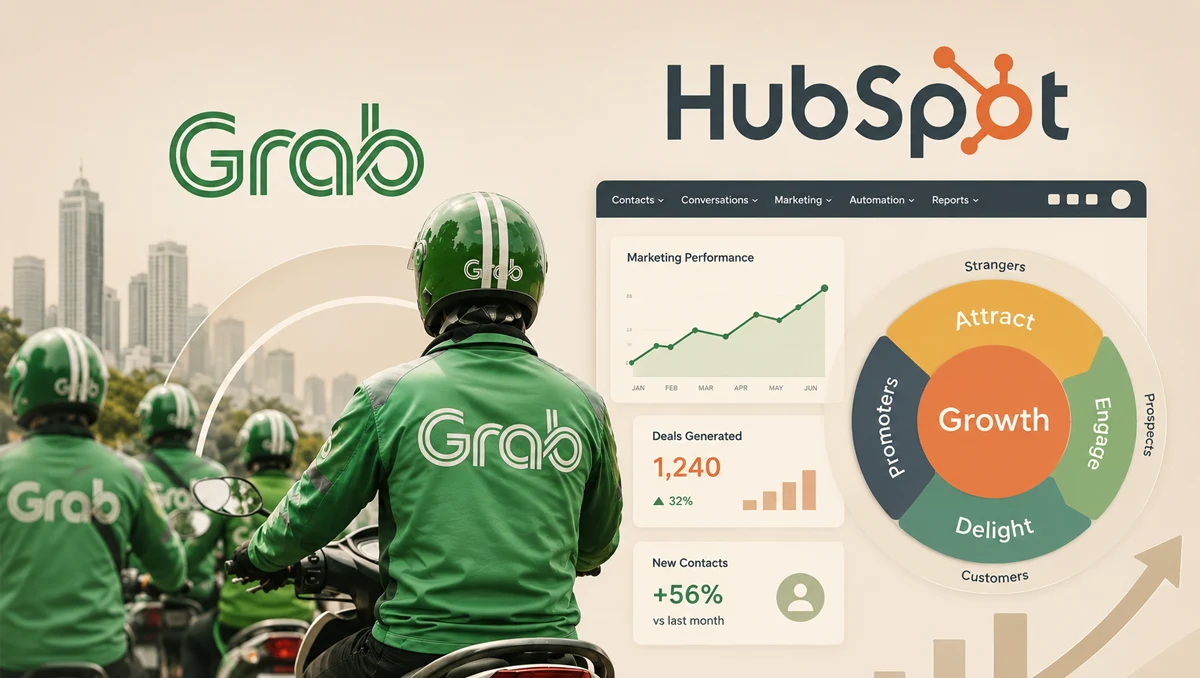
Before pulling the trigger on any investment, the first thing I always do is get to know the businesses inside out. When it comes to Grab, I use the app almost every single day, ranging from ride-hailing transportation to ordering food and drinks online. HubSpot ($HUBS), on the other hand, felt completely foreign to me. Because of that, I had to dedicate some time to research and truly understand it.
A Brief Profile of Grab and HubSpot
According to data from Investing.com, Grab Holdings Limited operates the Grab superapp across various Southeast Asian countries, including Cambodia, Indonesia, Malaysia, Myanmar, the Philippines, Singapore, Thailand, and Vietnam. The company offers a wide array of delivery services on its platform, such as GrabFood (food delivery), Dine-Out (table reservations), GrabMart (on-demand grocery shopping), GrabAds (online advertising solutions), and GrabExpress (package delivery).
Additionally, Grab provides the Grab for Business platform for corporate clients, the GrabKios merchant network, and mobility services like GrabCar, GrabTaxi, JustGrab, and GrabBike. Grab has also expanded deep into financial services through GrabFin—which offers digital lending, PayLater options, and insurance via GrabInsure—as well as digital banking deposits through Digibank Savings Account and GXS Bank debit cards. The company was founded in 2012 and is headquartered in Singapore.
Meanwhile, HubSpot, Inc., together with its subsidiaries, provides a cloud-based Customer Relationship Management (CRM) platform for businesses across the Americas, Europe, and the Asia-Pacific region. Their comprehensive CRM suite includes:
- Marketing Hub: Tools for marketing automation, email campaigns, social media management, and advanced SEO and analytics.
- Sales Hub: Email templates, conversation tracking, live chat, meeting scheduling, and sales pipeline management.
- Service Hub: Service software designed to help businesses manage customer feedback and seamlessly connect with clients.
- Content Hub: Solutions for website page optimization, business blogging, video/podcast hosting, and automated SEO recommendations.
- Operations & Commerce Hub: Tools for programmable data synchronization, subscription management, invoicing, and revenue reporting.
HubSpot also features Breeze, an AI technology that powers their customer platform by providing AI-driven insights, automated content generation, and Breeze Agents to help corporate teams automate workflows end-to-end. The company was incorporated in 2005 and is headquartered in Cambridge, Massachusetts.
Testing the Fair Value
After getting a baseline understanding of both companies, I needed to determine their intrinsic fair value. To do this, I utilized the analytical tools provided by Investing.com.
Based on consensus figures and automated financial valuation models, Investing.com places the fair value for Grab at USD 4.3 (representing an 18% upside from the market price at the time of writing). For HubSpot ($HUBS), the fair value is pinned at USD 276.6 (a substantial 37.8% upside compared to its current trading price).
Independent Technical Analysis
Even though I am well aware of their fair values, it doesn’t mean I should immediately jump in and buy. I still need to perform technical analysis based on my personal strategy, utilizing the EMA 200 to identify the primary macroeconomic trend and the MACD to measure the strength of bullish or bearish momentum.
1. Technical Analysis of Grab ($GRAB)
The primary trend for this stock is currently trapped in a bearish cycle, as the price has been hovering consistently below the EMA 200 line since November 2025. As per my standard routine, to map out the historical support levels, I drew a Fibonacci Retracement measuring the range between the swing low on June 20, 2025, and the swing high on September 24, 2025. The specific support level I am actively monitoring is sitting right at the Golden Ratio of 1.618, which translates to a price point of USD 3.17.
To the naked eye, Grab’s price has been bleeding down toward that Fibonacci support, but its downward trajectory has stalled within the USD 3.36 – USD 3.67 price channel. This is highly likely due to a legacy support block in that area; during the first semester of last year, Grab’s price corrected heavily and bottomed out in April around this exact zone.
The MACD indicator is currently flashing the early signs of a momentum shift from bearish (selling) to bullish (buying), as the MACD line has crossed above the signal line (golden cross). At market close as of writing, the exact metrics show a Histogram of 0.0024, a MACD line of -0.0699, and a signal line of 0.0723. This setup confirms an early shift from sell to buy. Even so, this does not yet guarantee a macro trend reversal, as a definitive structural shift will only be confirmed once a major legacy resistance level is broken on high volume.
2. Technical Analysis of HubSpot ($HUBS)
Much like Grab, HubSpot is stuck in a prolonged bearish trend according to the EMA 200, which has been playing out since March 2025—meaning this markdown phase has been going on for over a year.
To pinpoint its structural support, I used a Fibonacci Retracement stretching from the swing low in August 2024 to the swing high in February 2025. The key target support mapped by the 161.8 Fibonacci extension sits at USD 154.19.
HubSpot’s stock price has continued its steady decline toward this level, but the MACD indicator is now showing a clear exhaustion of bearish momentum. The MACD values at market close show a histogram of 0.5240, a MACD line of -7.94, and a signal line of -8.64. This initial crossover validates that the selling pressure is drying up, and buying volume is gradually returning to the market.
Tracking Institutional Smart Money
With the fundamental fair values established and my technical analysis mapped out, I checked HedgeFollow to see which institutional heavyweights are holding these two positions. I wanted to verify if “smart money” shared my thesis.
FOR Grab, the single largest position is held by Uber. Interestingly, there was massive institutional accumulation during the first quarter (Q1) of 2026. Based on the data I aggregated, Wall Street giants like BlackRock, Morgan Stanley, and other prominent funds scooped up over 187.2 million shares combined.
As for HubSpot, the top institutional block holders include T. Rowe Price Associates, BlackRock, Vanguard, and JPMorgan. The filing data reveals that these institutional players heavily increased their long positions throughout Q1 2026 while the stock was trading at a steep discount.
Execution Strategy: Maintaining Peace of Mind Through Scaling
The fundamental framework is solid, the technical levels are clear, and institutional accumulation is documented. The final step comes down to emotional discipline. Because the macro trend for both assets has not officially reversed into a verified bullish structure, the most logical approach is to scale into the market using a Dollar-Cost Averaging (DCA) strategy.
I have made the executive decision to open an initial entry position by allocating USD 250 into each stock.
I am explicitly choosing not to go all-in at these prices. I will let the market breathe and move naturally. I am keeping my cash reserves dry, waiting patiently to add more capital if the market gives me another opportunity to scale in at lower levels—ideally as close to their book value per share as possible.
Investing, for me here at Langit Sore, isn’t about predicting the future with absolute certainty; it’s about engineering a rational, stress-free plan that preserves peace of mind throughout the entire journey.
Have any thoughts?
Share your reaction or leave a quick response — we’d love to hear what you think!
-
 0
0 - 0
- 0
- 0
- 0
- 0


