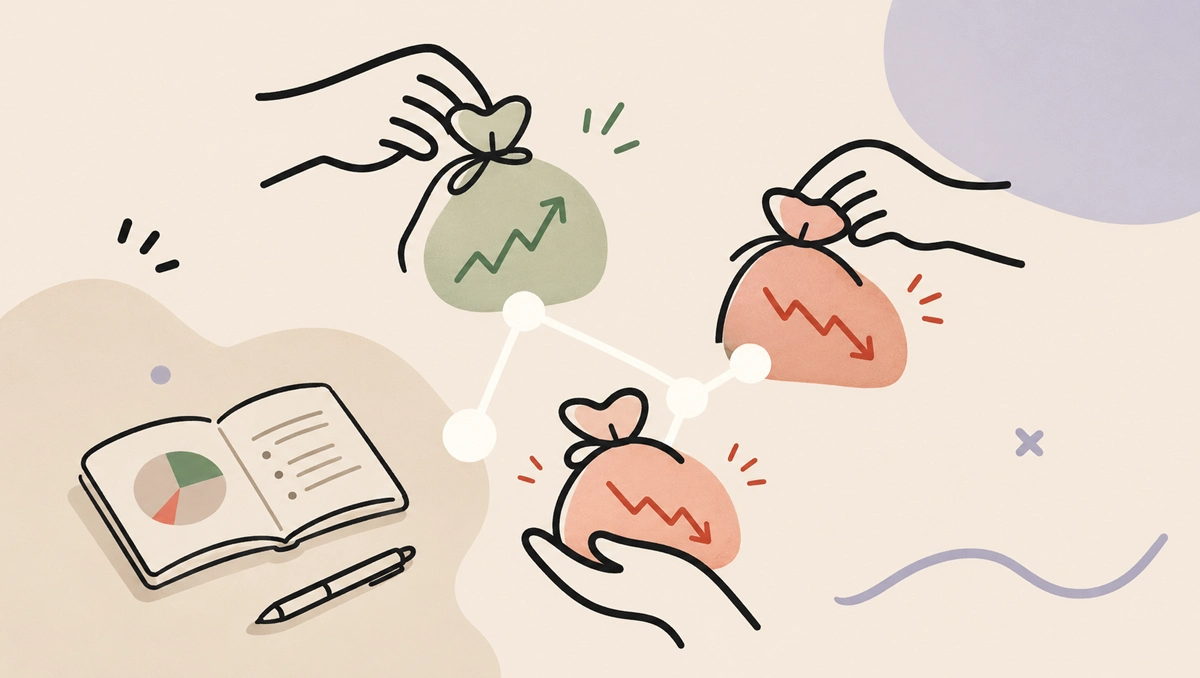
May 2026 did not give my portfolio a simple answer.
One pocket stayed green, but two others reminded me that investing is not only about chasing returns. It is also about placing money in the right container for the right life goal.
As of May 30, 2026, my portfolio performance has moved in different directions. Out of three investment pockets separated by purpose, only one posted a profit, while the other two remain in the red.
In aggregate, the growth from my long-term investment pocket was not enough to cover the losses from my short-term and debt-handling funds. The combined portfolio still records a net deficit of 970.81.
The figures in this review are based on my recorded initial and ending balances across each platform as of May 30, 2026. They are grouped by purpose, not by asset class.
May 2026 Portfolio Review
| Investment Goal | Platform | Initial Balance | Ending Balance | Profit / Loss | Percentage |
|---|---|---|---|---|---|
| Long-Term Investment | Pluang, Tokocrypto | 7,458.05 | 8,838.16 | +1,380.11 | +18.50% |
| Handle Loan Interest | Bareksa | 4,661.28 | 3,219.48 | -1,441.80 | -30.93% |
| Short-Term Funds (<5 Years) | IPOT | 5,158.48 | 4,249.36 | -909.12 | -17.62% |
At first glance, the green number from the long-term pocket looks encouraging. But when I look at the whole portfolio, the picture becomes more honest.
One part is growing. Two parts are still under pressure. And the total result is still negative.
That is the kind of reminder I need at the end of the month: not every positive number means the whole strategy is working, and not every red number means the whole journey has failed.
Quick Evaluation of Each Investment Pocket
Long-Term Investment: +18.50%
The long-term investment pocket is the main growth driver this month. My portfolio in Pluang and Tokocrypto ended May with a gain of 1,380.11, or 18.50% from the initial balance.
This pocket became the anchor of the entire portfolio.
But I do not want to treat this gain as a reason to become overconfident. The movement throughout May was still volatile. A green number can easily create the illusion that every decision was correct, even when the result may only be temporary.
For this pocket, the main lesson is discipline.
If the investment thesis remains intact, I can continue holding or adding gradually. But if the gain only makes me more aggressive without a clear reason, then the green number becomes a psychological trap.
Handle Loan Interest: -30.93%
The Bareksa pocket experienced the heaviest pressure this month. It declined by 1,441.80, or 30.93% from the initial balance.
This is the most uncomfortable part of the portfolio review.
The reason is not only the percentage loss. The bigger issue is the purpose behind this pocket. This fund is connected to handling loan interest, which means the emotional pressure is different from a normal investment drawdown.
When money is tied to debt, volatility feels heavier.
A decline in this pocket does not only affect the spreadsheet. It also affects the way I think, decide, and manage stress. That is why this part becomes my top evaluation priority for June.
The main question is simple: is this pocket placed in the right instrument for its purpose?
If the answer is no, then I need to consider switching into something more stable, even if that means accepting a loss or reducing potential upside.
Short-Term Funds: -17.62%
The short-term pocket in IPOT also closed May in the red. It declined by 909.12, or 17.62% from the initial balance.
This result gives a clear lesson: aggressive instruments may not be suitable for a time horizon under five years.
Short-term money should have a different job from long-term money. It should prioritize capital stability, liquidity, and peace of mind. If the value moves too aggressively, then the instrument may be misaligned with the goal.
This does not automatically mean the investment choice was wrong. But it does mean the purpose and the risk level need to be reviewed.
For short-term funds, the goal is not to win the highest return. The goal is to make sure the money is still available when needed.
What the Red Numbers Taught Me
The hardest part of reviewing a portfolio is not calculating the percentage.
The hardest part is being honest with what the numbers are saying.
The green pocket teaches me that patience can work. But the red pockets teach me something equally important: every investment must be matched with its purpose.
Long-term money can survive volatility better because it has more time.
Short-term money cannot always afford that luxury.
Money connected to debt carries a different psychological weight because the pressure is not only financial, but emotional.
This is why I do not want to look at my portfolio only from the return side. I also need to look at it from the risk, time horizon, and mental burden side.
A portfolio is not just a collection of assets. It is also a reflection of how I organize my financial life.
Action Plan for June 2026
For June 2026, my focus is not to chase instant profit.
My focus is to realign risk.
There are four possible decisions I will evaluate based on the latest market conditions and the original purpose of each pocket.
1. Top Up
I will consider topping up only if the original investment thesis remains intact and the asset price offers a reasonable discount.
This option should not be driven by emotion or the desire to “average down” blindly. It must be supported by a clear reason.
2. Hold
Holding remains an option if the decline is still within my tolerance limit and the purpose of the pocket is still aligned with the instrument.
Not every red number requires action. Sometimes, the best decision is to let the thesis play out.
3. Cut Loss or Switch
I will consider cutting loss or switching if an instrument proves too volatile for its original purpose.
This is especially important for short-term funds and the debt-handling pocket. If the instrument does not match the time horizon, forcing it to stay may create bigger problems later.
4. Wait and See
Doing nothing can also be a decision.
But it must be conscious, not passive. I want to observe the market without making impulsive moves, especially when emotions are high.
Wait and see does not mean ignoring the problem. It means giving myself space to think before taking action.
Final Reflection
This May 2026 portfolio review forced me to look at the numbers honestly.
One pocket gained. Two pockets lost. The total portfolio is still in deficit.
But beyond the numbers, this review helped me understand the difference between return and suitability.
A profitable investment is not always suitable for every goal. A volatile instrument may be acceptable for long-term growth, but dangerous for short-term needs. A red number may hurt, but it can also reveal where the structure needs to be fixed.
Green numbers teach humility.
Red numbers teach composure.
And both are part of the same financial journey.
Disclaimer
This note is personal and does not constitute a buy or sell recommendation for any investment instrument. Every financial decision is entirely the responsibility of each individual.
Have any thoughts?
Share your reaction or leave a quick response — we’d love to hear what you think!
-
 0
0 - 0
- 0
- 0
- 0
- 0


